


 USA
USA
 CANADA
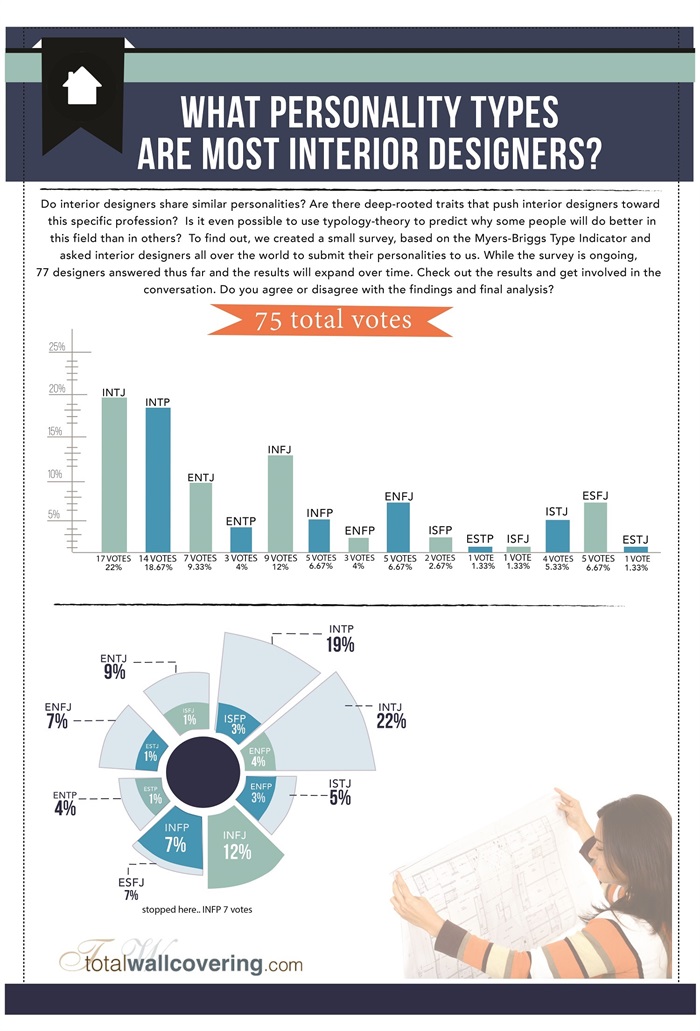
Three weeks ago, we started a discussion and poll to find out if certain Myers-Briggs personalities are more prevalent in the interior design industry than in other industries.
This was done in response to this article written by Michelle Roller from four years ago. We wanted to retest this data because the audience was mostly industrial designers, and we wanted to focus solely on interior designers.
People within the industry were asked on Facebook, Twitter, Houzz, InteriorDesign subreddit, and other forums if they could take the test and submit their MBTI results. The following pie chart represents the outcome in a span of two weeks.
Note: Two interior designers from Houzz submitted their personality without voting on the poll. They both were INTJs.
Introverted Intuition
Four of the top five most common personalities in this particular test all have one thing in common: introverted intuition (Ni). This cognitive function is the dominant or auxiliary function in over 60% of the people submitted their results to us. There seems to be a direct correlation between introverted intuition (Ni) and the mindset of most interior designers. This shouldn't be too surprising. Introverted intuition excels at building complex systems by subconsciously taking in sensory data, taking out the unnecessary components, and making sense of everything. It can be compared to solving a puzzle with its pieces scattered in different places. Ni can take the essence of multiple ideas, theories, or principals, and find out how they all fit together. Their ability to recognize patterns is nothing short of amazing. This would explain why INTJs, INFJs, ENFJs, and ENTJs would not only enjoy interior design, but be highly successful at it. They are natural long-term system builders, an acute sense of vision, and the ability to foresee with accuracy what designs are realistically feasible.
These four personalities can grasp and get the sense of the pattern or plan that their clients want. Once finished, Ni generates an impression that seems to come out of “nowhere.” But the fact is that the intuition did not come out of nowhere, but from a synthesis of sensory data gathered from the immediate environment combined with information from the INJ’s own psyche. Few other types would be better at accurately visualizing their client’s wishes, especially when they are vague or hard to understand.
Extroverted Feeling
Extroverted feeling (Fe) is an enthusiastic function that generally exudes charisma and bonds well with others. It's non-confrontational and, in its purest form, is always ready to lend a helping hand. Many are naturally drawn to people who have Fe has their dominant or auxiliary function because they tend to be warm, friendly individuals with highly developed interpersonal skills. It's also an expansive function that can juggle many tasks at once. High Fe people can multitask several projects and responsibilities without batting an eye. What would be stressful for many individuals is just another day at the office an Fe user. Their desire to connect with others is genuine and by an early age they have become quite adept at it. Most of them can spark a conversation in a heartbeat and instinctively know how to adjust their behavior to put others at ease. Both the ENFJ and INFJ have this Fe as their dominant or auxiliary function. This gives them a sizable advantage over other groups when it comes to interpersonal communication skills. They tend to be very comfortable around people, likable, and great at communicating their inspiration with other people. Note: The ESFJ did not crack the top five by they are not that far behind. They, like the ENFJ, use Fe as their dominant cognitive function.
Introversion
You might be surprised to learn that most interior designers are introverts. In fact, according to our sample size, 66% of the interior designers who submitted their personality were introverts. "What, how can that be since interior designers are always around people?" you might be asking. The truth is that the job of an interior designer is far different from how it appears. A large percentage of their time is actually spent drawing, planning, and conceptualizing a project. These professionals are expected to produce creative yet functional designs at times working with very unrealistic clients.
The life of an interior designer seems exciting and fun to many people. Many people think the job is so easy that anyone can do it. Household stars like Candice Olson or Genevieve Gorder always seem to be having a blast on television we tend to get a distorted perception of what they really do.
It all seems effortless to many. The wine tasting parties, after-hours networking events, and fun shopping selections that are usually posted on their Instagram accounts are only a fraction of what they do each day.
Step into an interior designer's office and you'll usually see charts, plans, and multiple clipboards like what's illustrated in this amusing infographic titled "What Interior Designers Do."
Contrary to what most people believe, these hardworking individuals are definitely not pillow fluffers you pay $10,000 just to make you feel good.
The Hidden Psychology Behind Interior Designers' Personalities – A Revealing Study
Three weeks ago, we embarked on an intriguing mission – to uncover whether specific Myers-Briggs personality types dominate the interior design world. What we discovered might completely change how you view this creative profession.
Why This Study Matters
While most people picture interior designers as bubbly extroverts focused solely on aesthetics, our research reveals a far more complex psychological profile. We conducted an extensive survey across multiple platforms (Facebook groups, design forums, Reddit communities, and professional networks) to gather authentic data about wallpaper choices.
Breaking Down the Findings
1. The Quiet Visionaries: Introverted Intuition Dominates
Our most striking discovery? A whopping 60% of interior designers rely on Introverted Intuition (Ni) as their primary or secondary cognitive function. These are your big-picture thinkers who can:
- Visualize complete designs from fragments of inspiration
- Anticipate spatial challenges before they arise
- Create cohesive environments that tell a story
Real-world example: An INTJ designer we interviewed described how she mentally "walks through" unfinished spaces to identify potential flow issues months before construction begins.
2. The Emotional Translators: Fe in Action
Contrary to the "diva designer" stereotype, the most successful professionals wield Extroverted Feeling (Fe) like a superpower. They:
- Decode clients' hesitant comments into clear design directions
- Mediate between stubborn contractors and anxious homeowners
- Create spaces that feel "just right" even when clients can't explain why
A senior designer (ENFJ) shared how she asks clients about their childhood homes to uncover deep-seated aesthetic preferences they never mention outright.
3. The Introvert Advantage
In our survey, 66% of designers identified as introverts. Here's why this makes perfect sense:
- 80% of design work happens alone (drafting, sourcing, planning)
- The best concepts emerge from deep, uninterrupted focus
- Client meetings are more productive after solitary preparation
4. The J Factor: Why Designers Need Structure
The 72% preference for Judging (J) over Perceiving (P) reflects the industry's demanding reality:
- Projects require military-level coordination of multiple vendors
- Budgets demand meticulous planning
- Clients expect concrete timelines
What This Means for the Industry
These findings have real-world implications:
- For firms: Stop forcing introverted designers into constant client schmoozing
- For educators: Teach spatial intuition alongside technical skills
- For clients: Understand why your designer needs quiet time to do their best work
Your Turn: Does This Ring True?
We want to hear from real designers:
- Do you find yourself mentally rearranging spaces in your head?
- Have you ever just "known" what a client wanted before they did?
- Does social interaction drain your creative energy?
Share your experiences in the comments – let's create the most accurate picture of design psychology together!
True, they have to be relatively good with people, which they can learn, but some of the best designers out there are actually reserved types who like to work in solitude. They come out of their shell to work with their clients and network their businesses, however, much of the work involves working tirelessly at their desks. The ASID sums up their job rather well one this page titled "What Does An Interior Designer Do." So what do you think? Are you surprised by any of these findings? Do you disagree with anything that's been written? Let us know your opinion. This post will continue to be edited should new data come in.